

TL;DR:
- Successful AI adoption depends on deliberate planning, assessment, and alignment with school context.
- Clear goals, stakeholder input, and careful tool selection are essential for impactful implementation.
- Repeated focus on equity, teacher support, and phased scaling fosters sustainable, responsible AI integration.
Adopting AI in your school is less about the technology itself and more about building the conditions for it to work well. Many districts jump straight to purchasing tools without a clear plan, only to find adoption stalls, teachers feel overwhelmed, and students don’t see measurable gains. The pressure to act is real, yet the cost of acting without a strategy is higher. AI adoption in schools can deliver a significant positive effect on academic achievement, with a meta-analysis effect size of 0.924, but only when implementation is deliberate, phased, and grounded in your school’s specific context. This guide walks you through exactly how to do that.
Table of Contents
- Assessing your school’s readiness for AI
- Setting clear goals and measurable outcomes
- Selecting safe, effective AI tools and practices
- Implementation: Building support and ensuring equity
- A fresh perspective on AI adoption in schools
- Next steps: Proven AI resources for your school
- Frequently asked questions
Key Takeaways
| Point | Details |
|---|---|
| Assess readiness first | Address privacy, equity, and staff development before introducing AI. |
| Set measurable goals | Define clear objectives and metrics to track the impact of AI initiatives. |
| Choose ethical tools | Select AI tools with pedagogical guardrails and robust privacy standards. |
| Pilot, then scale | Start small, collect feedback, and build community support before full rollout. |
| Monitor and adapt | Regularly evaluate outcomes and equity to sustain long-term success. |
Assessing your school’s readiness for AI
Before you select a single tool or schedule a training session, you need an honest picture of where your school stands. Readiness assessment is not a bureaucratic checkbox. It is the step that separates sustainable AI adoption from the kind of rollout that burns out teachers and wastes budget.
A solid readiness review covers four dimensions: technology infrastructure, staff capacity, policy alignment, and student population context. Use the checklist below as a starting point.
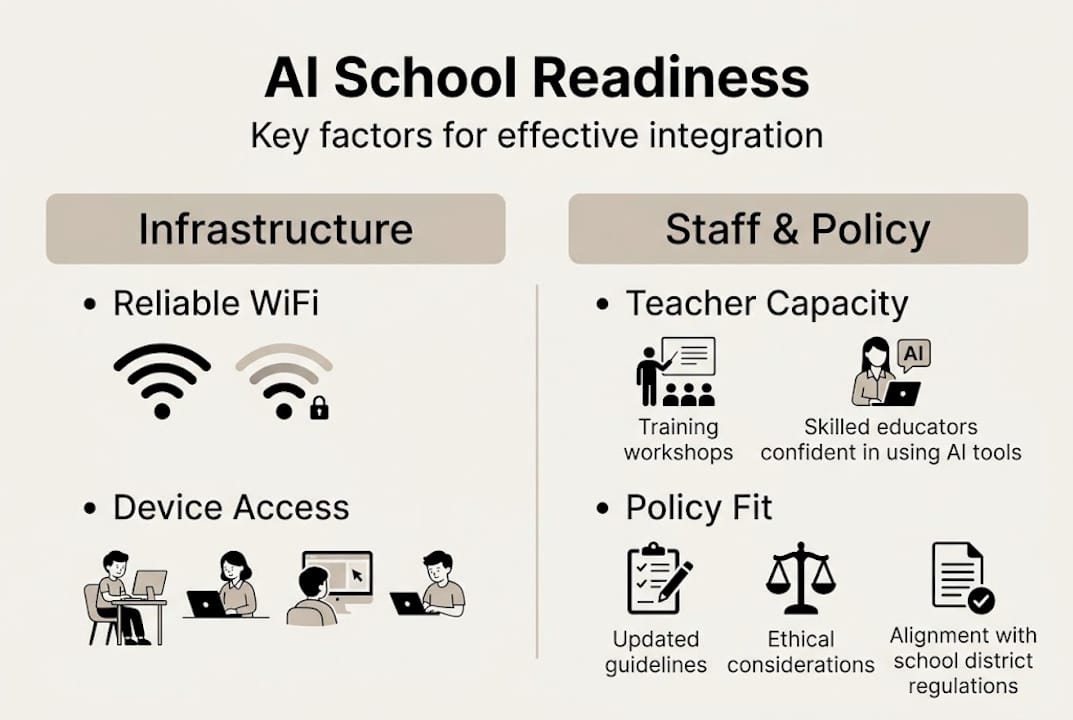
| Readiness area | Key questions to answer | Status |
|---|---|---|
| Infrastructure | Is broadband reliable across all classrooms? Are devices up to date? | Ready / Gap |
| Staff capacity | Do teachers have baseline AI literacy? Is PD time budgeted? | Ready / Gap |
| Policy alignment | Are data privacy and acceptable use policies current? | Ready / Gap |
| Student population | Are equity gaps identified? Do underserved students have device access? | Ready / Gap |
UNESCO’s guidance on AI in education emphasizes human-centered regulation, specifically data privacy protections, age-appropriate limits, ethical validation processes, and AI literacy competencies as foundational readiness requirements, not afterthoughts.
Common obstacles at this stage include low AI literacy among staff, vague or competing goals across departments, and insufficient teacher buy-in. Naming these gaps early gives you a realistic timeline and helps you prioritize where to invest first. Explore the AI in education overview for a broader picture of where schools are seeing the strongest early returns.
The most overlooked readiness factor is staff mindset. Teachers who feel AI is being done to them rather than with them are far less likely to integrate it meaningfully. Early conversations about purpose matter more than most administrators realize.
Pro Tip: Launch a small pilot with 2 to 3 willing teachers before any school-wide rollout. This surfaces readiness gaps in a low-stakes environment and builds an internal evidence base you can share with skeptics.
Understanding how AI-powered tools impact day-to-day classroom practice can also sharpen your readiness criteria before committing to a direction.
Setting clear goals and measurable outcomes
With your baseline established, the next step is to clarify why you’re investing in AI and how you’ll define success. Without specific goals tied to real priorities, AI initiatives tend to drift, producing activity without outcomes.
Effective goal-setting starts with stakeholder input. Teachers, counselors, students, and families each see different problems, and the best AI objectives address shared pain points, not just administrative priorities. Once you have that input, define metrics that are observable and reviewed on a predictable schedule.
Here is a proven goal-setting sequence:
- Gather stakeholder input from teachers, students, families, and district leadership through surveys or working sessions.
- Define priority outcome areas, such as improved early literacy rates, reduced administrative processing time, or greater equity in advanced course enrollment.
- Set specific, measurable targets with a baseline, a time frame, and a responsible owner for each.
- Apply an equity lens by asking whether each goal addresses the needs of your highest-need student populations first.
- Secure formal approval from district leadership and your board so goals have institutional weight and protected resources.
- Schedule regular reviews at the 30, 60, and 90-day marks during any pilot phase.
The research supports investing in this rigor. A meta-analysis on AI in K-12 found an effect size of 0.924 for AI’s impact on academic achievement, which is a very large effect by educational research standards. But that effect is not automatic. It emerges when interventions are targeted and monitored.
Sample goals worth considering include reducing teacher grading time by 30 percent, improving third-grade reading fluency scores by 10 percentile points, or increasing the percentage of English learners meeting grade-level benchmarks. Review implementing AI in education for frameworks that link these goal types to specific tool categories. You can also explore AI for student engagement to see how engagement metrics translate into outcome data.
Selecting safe, effective AI tools and practices
Once your goals are clear, it’s time to select the right AI solutions for your classrooms. Not all AI tools carry the same risk profile, and the selection process deserves as much rigor as your goal-setting did.
Start with evaluation criteria that map directly to your goals and your student population’s needs. The key factors to weigh are alignment with your defined outcomes, data privacy features including FERPA and COPPA compliance, ease of teacher oversight and correction, and evidence of efficacy in comparable school settings.
When vetting providers, ask these questions:
- What student data is collected, where is it stored, and who can access it?
- Is there peer-reviewed or independently validated evidence that the tool improves outcomes?
- Can teachers see what the AI is doing and override it when needed?
- Is the pricing model sustainable for your district budget over three to five years?
- What does onboarding and ongoing support look like?
Stanford research on AI tool efficacy reviewed 20 high-quality causal studies and found that AI improves student performance during use, but results are mixed once the tool is removed. Tools with built-in pedagogical guardrails produced better long-term learning and reduced dependency risks. This is a critical finding. You want tools that teach, not tools that simply perform tasks for students.
The stakes of getting selection wrong are significant. As a Brookings premortem across 50 countries warned, the current risks of AI in schools, including cognitive stunting, overreliance, equity gaps, and privacy violations, outweigh the benefits without structured, validated integration. That is not a reason to avoid AI. It is a reason to choose carefully.
| Tool type | Pedagogical guardrails | Data privacy rating | Evidence base |
|---|---|---|---|
| Adaptive tutoring platforms | Strong | High (COPPA compliant) | Multiple RCTs |
| AI writing assistants | Variable | Moderate | Limited K-12 studies |
| Automated grading tools | Moderate | High | Emerging evidence |
| General-purpose chatbots | Weak | Low | Minimal K-12 data |
Pro Tip: Use the AI tools checklist to score each vendor against your criteria before demos. This keeps your evaluation objective and saves time. The step-by-step AI education guide also provides a structured framework for matching tool types to instructional goals.
Implementation: Building support and ensuring equity
With vetted tools in hand, the next challenge is to bring your community on board and implement equitably. Even the best-selected tool will underperform if teachers lack confidence, families lack context, or underserved students lack access.
Follow this implementation sequence to reduce those risks:
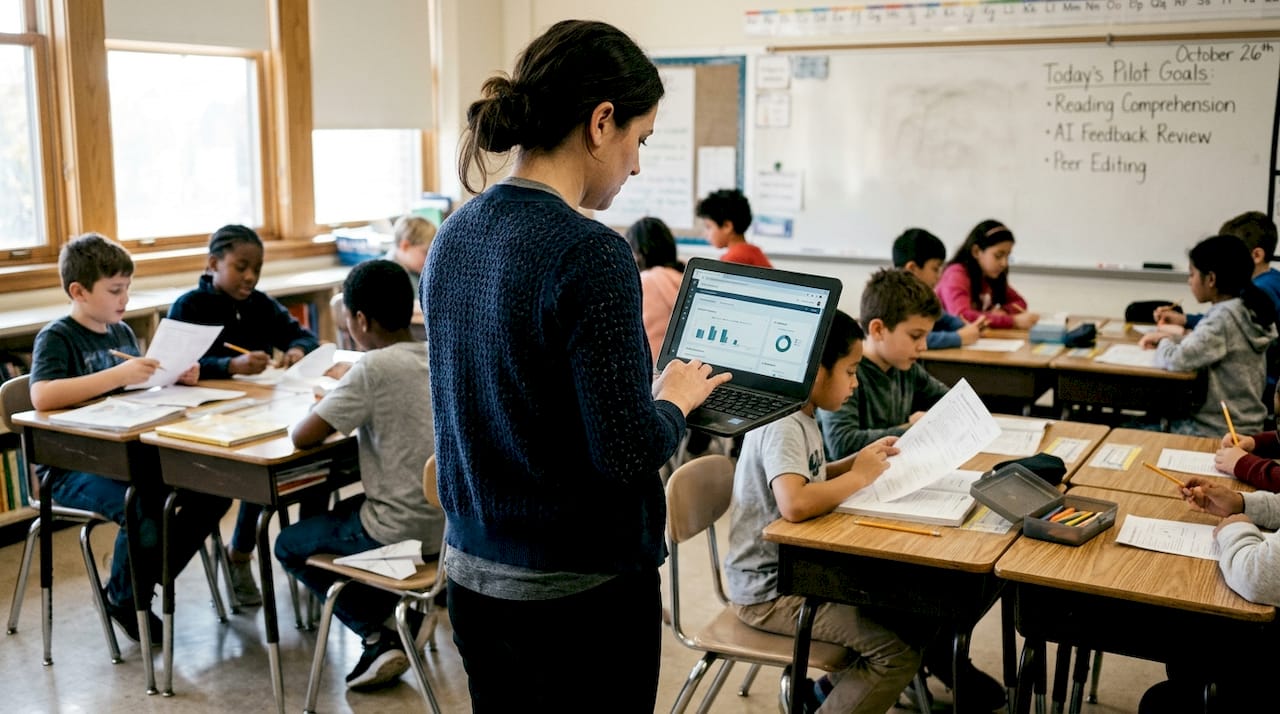
- Launch a focused pilot with volunteer teachers in 1 to 2 grade levels or subject areas. Define what you are testing and for how long.
- Collect structured feedback from pilot teachers and students at the midpoint and end of each cycle.
- Review equity data by disaggregating outcome data by student subgroup to catch early signs of gap widening.
- Adjust before scaling based on pilot findings. Do not expand until you have addressed the main friction points.
- Build a tiered rollout plan that sequences adoption by readiness level rather than forcing simultaneous adoption across all classrooms.
- Communicate progress to families, board members, and community partners at each phase transition.
Key staff roles that must be clearly defined include:
- Professional development leads who design and deliver teacher training tailored to your specific tools and goals
- Technology integrators who troubleshoot access issues and model classroom AI use alongside teachers
- Counselors and student support staff who monitor student wellbeing and flag signs of overreliance or disengagement
Equity cannot be addressed at the end. Common Sense Education’s AI toolkit recommends starting small with pilots aligned to goals, investing in teacher professional development and equity frameworks before any district-wide scaling. That sequencing protects your most vulnerable students from being used as a testing ground for unproven approaches.
Review AI adoption strategies for district-level implementation models. You can also find AI curriculum ideas that embed equity-first thinking directly into instructional design.
A fresh perspective on AI adoption in schools
Most schools that struggle with AI adoption are not failing because they chose the wrong tool. They are failing because they skipped the reinvention phase. Research on AI adoption in education describes a pattern: fear, acceptance, dependence, and reinvention. The four stages of AI integration outlined by the U.S. Department of Education show that schools often rush through fear and acceptance, land in dependence, and never reach the reinvention phase where ethical, creative, and pedagogically sound use becomes normalized.
Conventional wisdom says faster adoption signals leadership and innovation. We think that framing is exactly backwards. Rapid AI integration without intentional reinvention can widen equity gaps, erode foundational skills like writing and reasoning, and create a fragile dependence on tools that may change or disappear. The schools we see building durable AI programs are not the fastest adopters. They are the most deliberate.
The most honest lesson from earlier edtech waves is that technology rarely fails on technical grounds. It fails when stakeholder alignment is weak, when regulation lags behind practice, and when success is defined by adoption rates rather than learning outcomes. For a look at the future of AI in schools, the trajectory favors institutions that treat AI as a continuously evolving practice, not a one-time implementation project.
Next steps: Proven AI resources for your school
Moving from strategy to action is where many schools stall, not for lack of intention, but for lack of structured support. At Airitual, we work with educational institutions to design phased AI integration plans that are grounded in evidence, built around your specific goals, and sensitive to the equity and privacy priorities your community expects. Explore our AI in education solutions to see how we approach this work. Our AI integration best practices resource offers frameworks you can apply right now, and our step-by-step AI education guide provides a sequenced action plan tailored to school contexts. Schedule a FREE Strategy Session to discuss your district’s priorities with our team.
Frequently asked questions
What are the most common risks of AI in schools?
Cognitive stunting, overreliance, widening equity gaps, and privacy violations are the most frequently cited risks. A Brookings analysis across 50 countries found these risks outweigh benefits when structured safeguards are absent.
Which AI tools are best for K-12 education?
Tools with strong pedagogical guardrails and independently validated efficacy studies perform best in K-12 settings. Stanford’s research review confirms that guardrail-equipped tools produce better outcomes and reduce dependency risk compared to general-purpose alternatives.
How do we measure AI’s impact on student outcomes?
Define your target metrics before launch, such as reading fluency levels or course completion rates, and track them against your pre-AI baseline at regular intervals. A meta-analysis on AI in education demonstrates that measurable effect sizes are achievable when interventions are clearly targeted.
How can we ensure equity when adopting AI in schools?
Start with a pilot that intentionally includes underserved student populations, disaggregate your outcome data by demographic group, and prioritize those findings before scaling. The Common Sense AI toolkit recommends embedding equity frameworks into professional development before any broader rollout.
What are the first steps for AI integration in a school?
Assess your technology infrastructure, staff capacity, and policy alignment, then define clear success metrics before selecting any tools. The Common Sense AI toolkit for school districts advises starting small with goal-aligned pilots and reviewing progress systematically before expanding.
Recommended
- How to Implement AI in Education for Enhanced Results | Artificial Intelligence
- Educational AI Adoption Guide for Effective Integration | Artificial Intelligence
- 7 Key Types of AI Strategies for Educational Success | Artificial Intelligence
- 7 Essential AI Strategy List Tips for IT Managers | Artificial Intelligence
Recent Comments