

When integrating artificial intelligence into your K-12 institution, the biggest challenges often involve connecting technology goals with your community’s real needs. Educational administrators and technology coordinators worldwide grapple with questions around readiness, staff training, and data reliability. A strategic approach addressing organizational readiness for AI adoption can help you align tools with your academic mission, strengthen staff confidence, and set a clear path toward measurable improvements in student engagement and administrative efficiency.
Table of Contents
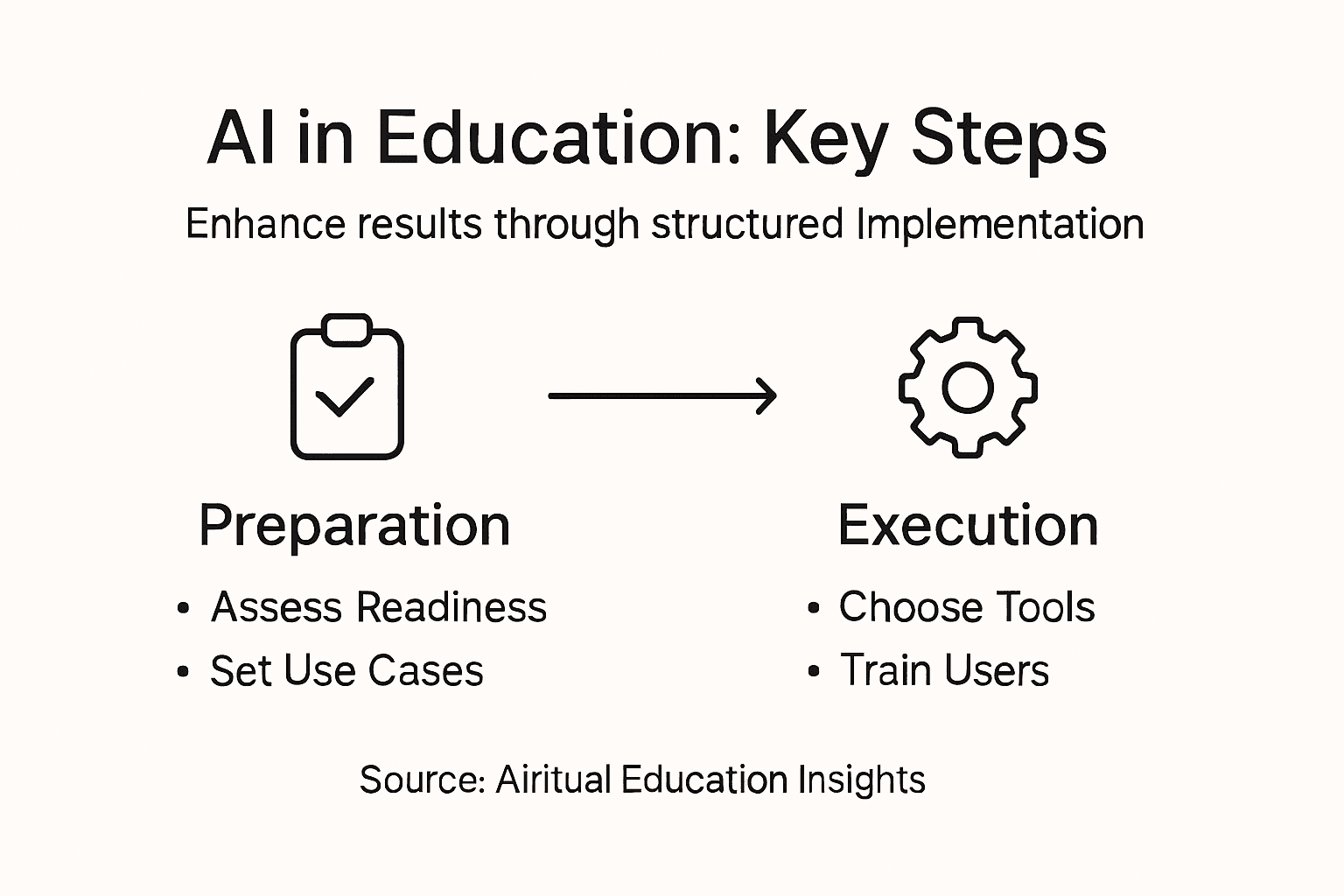
- Step 1: Assess Organizational Readiness For AI Adoption
- Step 2: Define AI Use Cases And Success Metrics
- Step 3: Select The Right AI Tools And Partners
- Step 4: Deploy AI Solutions And Train Users
- Step 5: Monitor Outcomes And Optimize Implementations
Quick Summary
| Key Insight | Explanation |
|---|---|
| 1. Assess readiness across domains | Evaluate technological infrastructure, human skills, and institutional culture for AI adoption. This helps identify gaps in preparedness. |
| 2. Define specific AI use cases | Identify tailored AI applications that align with institutional goals and address existing educational challenges. |
| 3. Prioritize ethical AI tools | Select AI tools and partners that emphasize ethical considerations, data privacy, and effective support for academic needs. |
| 4. Train users comprehensively | Implement phased training programs addressing technical skills and ethical use of AI to enhance user confidence and effectiveness. |
| 5. Monitor and optimize continuously | Develop a systematic monitoring framework to track implementation success and incorporate feedback for ongoing improvement. |
Step 1: Assess Organizational Readiness for AI Adoption
Assessing your educational institution’s readiness for AI adoption requires a strategic approach that examines multiple dimensions of technological and human capabilities. This step will help you understand your organization’s potential for successful AI integration by evaluating key preparedness factors.
Start by conducting a comprehensive assessment across three critical domains: technological infrastructure, human skills, and institutional culture. Measuring teachers’ AI readiness involves examining technology self-efficacy, interaction capabilities, and ethical awareness. Begin by surveying your staff’s current technological comfort levels, understanding their existing digital skills, and gauging their openness to artificial intelligence tools.
Next, analyze your strategic alignment and data ecosystem. Organizational AI adoption factors highlight the importance of trust, management support, data quality, and skill development. Review your current technological resources, assess the quality and accessibility of your institutional data, and determine whether your leadership team supports technological innovation. Create a detailed assessment matrix that scores your organization across these dimensions to identify potential gaps and development opportunities.
Pro tip: Conduct anonymous staff surveys to understand psychological readiness and potential resistance points before launching any AI implementation initiatives.
Here’s a summary of critical domains in assessing organizational AI readiness:
| Readiness Domain | Key Factors to Evaluate | Typical Challenges |
|---|---|---|
| Technological Infrastructure | System compatibility, data access | Legacy systems, incomplete data |
| Human Skills | Staff digital literacy, AI self-efficacy | Lack of training, resistance |
| Institutional Culture | Leadership support, openness to change | Trust issues, slow adoption |
Step 2: Define AI Use Cases and Success Metrics
Defining clear AI use cases and success metrics is crucial for transforming educational technology from a theoretical concept to a practical implementation strategy. This step will help you identify specific applications of artificial intelligence that align with your institution’s unique goals and create measurable indicators of progress.
Begin by mapping out potential AI applications in higher education, focusing on areas like personalized learning pathways, automated assessment systems, and interactive learning environments. Prioritize use cases that directly address existing educational challenges such as student engagement, administrative efficiency, and learning outcomes. Consider scenarios where AI can provide targeted support such as adaptive tutoring, early intervention for at-risk students, or customized curriculum development.

Next, develop a comprehensive metrics framework to track AI implementation effectiveness. Measuring AI success metrics involves establishing quantitative and qualitative indicators that demonstrate tangible educational improvements. Your metrics should encompass student engagement levels, operational efficiency gains, learning outcome enhancements, and ethical AI usage compliance. Create a balanced scorecard that includes both technological performance indicators and pedagogical impact measurements to provide a holistic view of your AI integration strategy.
Pro tip: Create a pilot program with clearly defined success metrics before full-scale implementation to validate your AI strategy and build institutional confidence.
Below is a quick comparison of common AI use cases in education and their impact:
| AI Use Case | Educational Benefit | Success Measurement |
|---|---|---|
| Personalized Learning | Tailored student progress | Completion rate increase |
| Automated Assessment | Saves grading time | Efficiency improvement |
| Early Intervention Alerts | Reduces dropout risk | Retention statistics |
Step 3: Select the Right AI Tools and Partners
Selecting appropriate AI tools and partners is a critical step in successfully integrating artificial intelligence into your educational ecosystem. This process requires a strategic approach that balances technological capabilities with your institution’s specific academic needs and ethical considerations.
Begin by comprehensively evaluating AI tools for academic research, focusing on tools that offer robust features for literature reviews, data analysis, and research efficiency. Prioritize solutions that demonstrate strong integration capabilities, user friendly interfaces, and alignment with academic research methodologies. Consider factors such as data privacy, algorithmic transparency, and the tool’s ability to support diverse research disciplines.
When selecting AI partners, look beyond technological features to assess their commitment to ethical AI implementation. AI tools for research support should not only provide advanced functionality but also demonstrate a clear understanding of academic integrity and institutional requirements. Evaluate potential partners based on their track record of reliability, ongoing support, customization options, and their ability to evolve alongside emerging educational technology trends.
Pro tip: Request comprehensive demonstrations and pilot testing opportunities from potential AI tool providers to ensure their solutions genuinely meet your institution’s unique research and educational needs.
Step 4: Deploy AI Solutions and Train Users
Deploying AI solutions and training users represents the pivotal moment where strategic planning transforms into practical implementation. This step requires a methodical approach that balances technological integration with comprehensive user education and support.
Global guidelines for AI education deployment emphasize creating a systematic rollout strategy that prioritizes equitable access and professional development. Begin by developing a phased implementation plan that introduces AI tools incrementally, starting with pilot groups of educators and administrators who can provide feedback and help refine the deployment process. Design targeted training modules that address technical skills, ethical considerations, and practical application strategies for AI technologies across different educational contexts.
Focus on building a comprehensive support ecosystem that empowers users to confidently integrate AI tools into their daily workflows. Generative AI guidance for education highlights the importance of creating human-centric policies that support continuous learning and adaptation. Establish clear communication channels, provide ongoing technical support, and create collaborative spaces where educators can share experiences, challenges, and innovative approaches to AI implementation.
Pro tip: Create a dedicated internal resource hub with video tutorials, quick reference guides, and regularly updated best practices to support continuous learning and user confidence.
Step 5: Monitor Outcomes and Optimize Implementations
Monitoring AI implementation outcomes and systematically optimizing your approach is crucial for ensuring sustained educational value and technological effectiveness. This step transforms your AI strategy from a static plan into a dynamic, responsive system of continuous improvement.
Learning analytics for AI evaluation provides a robust framework for tracking implementation success across multiple dimensions. Develop a comprehensive monitoring system that captures quantitative metrics like student engagement rates, learning outcome improvements, and operational efficiency gains. Create dashboards that track key performance indicators, allowing you to visualize progress and identify areas requiring refinement. Implement regular feedback loops that capture qualitative insights from educators, administrators, and students to complement your quantitative data.
Systematic review of AI deployments emphasizes the importance of collaborative stakeholder engagement in optimization processes. Schedule quarterly review sessions where implementation teams can analyze collected data, discuss challenges, and collaboratively develop strategies for continuous improvement. Remain flexible in your approach, recognizing that AI technologies evolve rapidly and your implementation strategy must adapt to emerging best practices and technological advancements.
Pro tip: Establish a dedicated cross functional team responsible for ongoing AI performance assessment and strategic optimization to ensure agile and responsive implementation.
Unlock Your Educational Institution’s AI Potential with Expert Guidance
Implementing AI in education comes with complex challenges such as assessing readiness, selecting the right tools, and crafting measurable success metrics. If your institution struggles with integrating AI to enhance personalized learning, optimize administrative workflows, or monitor outcomes effectively, you are not alone. Common hurdles like limited staff AI skills, data quality issues, and adoption resistance can stall progress and hinder the transformative impact AI promises.
At Airitual, we specialize in partnering with educational organizations to overcome these pain points through tailored AI solutions designed to fit your unique needs. Whether you need strategic consulting on organizational readiness, help defining effective AI use cases, or hands-on support to deploy and optimize AI tools, our community-embedded experts ensure your technology adoption empowers educators and students alike.
Take decisive action today to accelerate your AI journey. Explore how our AI-powered tools for education can simplify implementation and maximize results. Don’t wait to transform learning outcomes. Start by booking a free strategy session through our website and step confidently into an AI-enhanced future.
Frequently Asked Questions
How can I assess my educational institution’s readiness for AI adoption?
Assess your organizational readiness by examining three key domains: technological infrastructure, human skills, and institutional culture. Conduct surveys to understand staff comfort levels with technology and identify gaps in skills and support. Start this process by gathering feedback within 30 days to identify areas that need improvement.
What are effective AI use cases for enhancing education?
Effective AI use cases in education include personalized learning pathways, automated assessment systems, and early intervention alerts for at-risk students. Map out these potential applications to directly address your institution’s specific challenges in student engagement and learning outcomes. Identify and prioritize at least three use cases to focus on in your implementation plan.
How should I select the right AI tools for my educational institution?
Choose AI tools that match your specific academic needs by evaluating their features, user interfaces, and ethical practices. Consider tools that integrate seamlessly with your existing systems and support your educational methodologies. Conduct thorough demonstrations and pilot tests within 60 days to ensure they meet your requirements.
What steps should I take to train users after deploying AI solutions?
After deploying AI solutions, create targeted training programs that focus on technical skills, ethical considerations, and practical applications of AI technologies. Start with pilot groups of educators and gather feedback to continuously improve the training materials. Aim to have a comprehensive training schedule in place within the first month of deployment.
How can I effectively monitor and optimize AI implementation outcomes?
Implement a monitoring system that tracks both quantitative metrics—like student engagement and operational efficiency—and qualitative feedback from users. Schedule regular reviews and discussions to assess performance and adapt strategies based on collected data. Establish quarterly review sessions to ensure a responsive and effective AI strategy.
Recent Comments