

TL;DR:
- Manual tasks cost SMEs time, introduce errors, and slow decision-making.
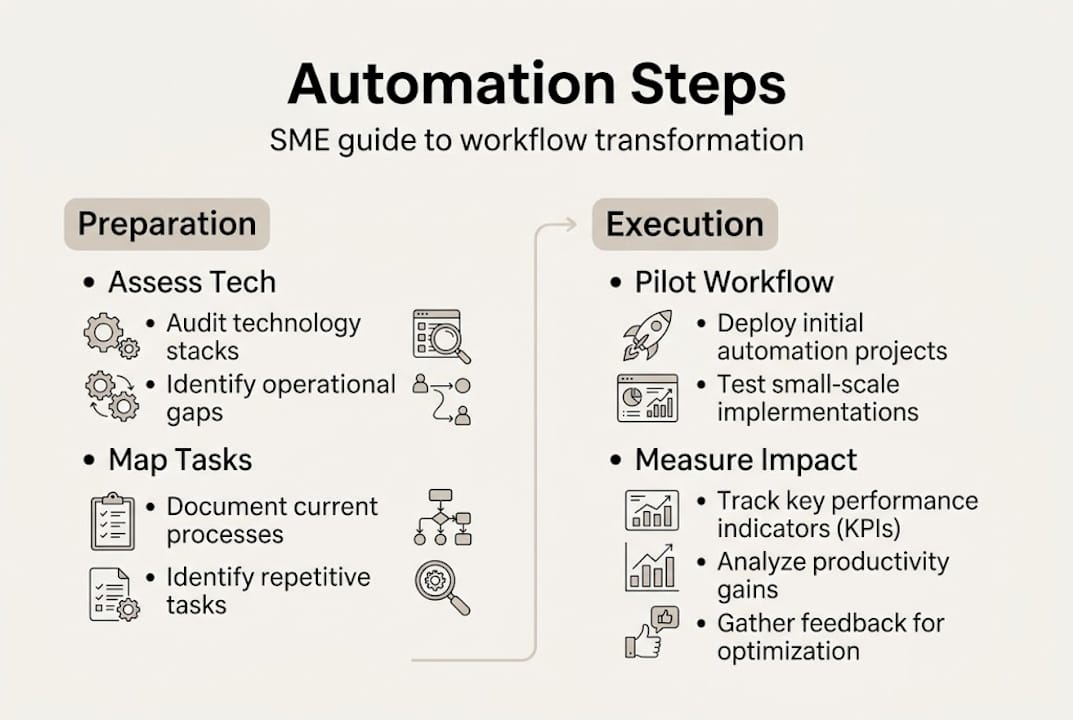
- Successful automation requires assessing readiness, prioritizing workflows, piloting, measuring, and scaling.
- Cultural buy-in, continuous improvement, and strong governance are crucial for long-term automation success.
Manual, repetitive tasks are costing your business more than time. They drain your team’s focus, introduce errors, and slow decisions that should take seconds. For small and medium enterprises, the gap between manual operations and AI-powered automation is widening every year. The good news: you don’t need a massive IT budget or a dedicated data science team to close that gap. This guide walks you through a proven, step-by-step approach to business automation with AI, from auditing your current processes to scaling results across your entire organization. Each stage is practical, measurable, and built for real SME conditions.
Table of Contents
- Assess your automation readiness
- Map and prioritize automation opportunities
- Select and pilot your first automated workflow
- Monitor, measure, and scale automation success
- Why most automation projects fail (and how to win)
- Ready to make automation work for your business?
- Frequently asked questions
Key Takeaways
| Point | Details |
|---|---|
| Preparation is critical | Assessing your readiness and workflows upfront prevents wasted effort and sets automation up for success. |
| Start small and scale | Effective business automation begins with piloting a single workflow and expanding after proven results. |
| Measure what matters | Track ROI, customer satisfaction, and error rates to guide continuous improvement and smart scaling. |
| Governance is essential | Prioritize ethical AI use, data privacy, and human oversight to manage risks as you automate. |
Assess your automation readiness
Before purchasing any software or assigning an automation project lead, you need an honest look at where your business stands today. A readiness audit isn’t just a formality. It’s the decision that separates companies that see real ROI from those that spend months chasing a misaligned technology investment.
Consider a straightforward fact: only 39% of businesses see significant AI impact, even though 88% use AI in at least one function. That gap exists because most organizations skip the readiness phase entirely.
Start by evaluating your workflows against three core criteria:
- Repetitive and high-volume: Tasks done the same way, dozens of times per day or week
- Error-prone: Manual data entry, copy-paste operations, or steps dependent on individual memory
- Data-driven: Processes that rely on pulling, sorting, or reporting structured information
Next, check your technology stack. Automation tools need to connect with your existing systems, whether that’s your CRM, accounting platform, or customer support software. Incompatible integrations are one of the top reasons automation pilots fail before they even launch.
| Readiness factor | Low readiness | High readiness |
|---|---|---|
| Process documentation | Ad hoc, informal | Fully documented SOPs |
| Technology integrations | Siloed legacy systems | API-connected platforms |
| Staff openness | Resistance or uncertainty | Active interest in tools |
| Data quality | Inconsistent or incomplete | Clean, structured data |
Change management is equally critical. Your team’s mindset toward automation shapes adoption outcomes more than the software you pick. Involve staff early, explain what changes and what stays the same, and frame automation as a tool that removes the tedious work, not the people doing it.
Pro Tip: Map your three most frustrating recurring tasks this week. If each one fits the criteria above, you already have strong business process excellence candidates ready for the next phase.
Map and prioritize automation opportunities
After confirming readiness, it’s crucial to identify exactly where automation can bring the most value. Not all processes are equal, and investing in the wrong one first can stall momentum before it builds.

High-performing companies gain over 5% EBIT improvement from AI by focusing on process redesign for growth and efficiency, not just plugging in tools. That distinction matters enormously for SMEs with limited runway.
Use a scoring table to rank your automation candidates objectively:
| Workflow | Volume (1-5) | Error rate (1-5) | Strategic value (1-5) | Effort to automate (1-5) | Total score |
|---|---|---|---|---|---|
| Invoice processing | 5 | 4 | 4 | 3 | 16 |
| Lead follow-up emails | 4 | 3 | 5 | 2 | 14 |
| Inventory updates | 3 | 4 | 3 | 4 | 14 |
| Employee onboarding | 2 | 2 | 4 | 4 | 12 |
Score each workflow on volume, error rate, strategic value, and automation effort. Higher total scores rise to the top of your roadmap. This approach removes the guesswork and personal bias that often derail prioritization conversations.
Here’s a step-by-step method to document and rank your opportunities:
- List every recurring workflow your team performs weekly
- Assign scores using the table criteria above
- Separate quick wins (high score, low effort) from strategic plays (high score, high effort)
- Document the current workflow in detail: inputs, steps, decision points, and outputs
- Define a clear success metric for each candidate before any tool selection begins
When you automate business workflows in this structured way, you create a measurable before-and-after baseline. That baseline is what you’ll use to justify further investment and prove value to stakeholders. Review your full automation workflow guide for templates that simplify this documentation process.
Select and pilot your first automated workflow
With a prioritized roadmap in hand, the next focus is executing your first automation pilot safely and successfully. Your highest-scoring, lowest-risk workflow is the right starting point. Resist the urge to automate multiple processes at once. A single, well-executed pilot teaches you far more than three rushed ones.
Follow this sequence:
- Select the workflow with the best score-to-effort ratio from your prioritized list
- Define success criteria before you start: target error reduction, time saved per week, or cost per transaction
- Choose your automation tool and configure it against a small, controlled data set
- Run the automated process in parallel with your existing manual process for the first 30 days
- Assign a human reviewer to compare outputs and log any discrepancies
- Refine the workflow based on real feedback before expanding the scope
Pro Tip: Never retire the manual process until the automated version has produced accurate results for at least 30 consecutive business days. This parallel approach protects your operations and builds internal confidence.
Timing is realistic but not instant. A 30 to 90 day pilot, run in parallel with manual review and human oversight, typically leads to a full rollout in 3 to 9 months. Most SMEs reach payback within 6 to 12 months after deployment.
The goal of a pilot isn’t perfection. It’s learning. Every edge case your team catches during parallel review makes the final rollout stronger and more resilient.
Keep in mind that workflow optimization strategies evolve as your tools and team mature. Build in a formal feedback checkpoint at day 30 and day 60. Ask your team: What’s working? What’s producing unexpected results? Where does human judgment still need to step in? These checkpoints are what turn a pilot into a reliable, scalable system. Well-designed AI-powered workflows should feel like a natural extension of your team’s decisions, not a replacement for them.
Monitor, measure, and scale automation success
Completing a pilot opens the door for ongoing evaluation and organization-wide expansion. Measurement isn’t optional at this stage. It’s the mechanism that proves value, earns buy-in from leadership, and guides your next automation investment.
Focus on these key performance indicators as your primary tracking framework:
- ROI: Compare time saved and error costs avoided against the total cost of implementation
- Error rate: Track defect frequency before and after automation using your documented baseline
- Customer satisfaction: Monitor response times, resolution rates, and feedback scores for customer-facing workflows
- Employee experience: Measure how staff perceive the change through brief monthly check-ins
- Process throughput: Track how many transactions or tasks the automated system handles per day versus the manual equivalent
Stat to know: SMEs that establish clear governance around ethical AI use and data privacy are significantly more likely to sustain automation gains long-term. This isn’t a compliance checkbox. It’s a business continuity practice.
Robust governance means defining who owns each automated workflow, setting audit intervals, and maintaining human oversight on any AI decisions that affect customers or sensitive data. Build these controls into your process from day one.
For scaling beyond the pilot, use a phased model. After one successful workflow, replicate the scoring and documentation approach for the next two candidates on your prioritized list. Start measuring AI impact across each new workflow using the same KPI framework you established in the pilot. This creates comparability across your entire automation portfolio.
Leadership teams that treat AI impact for business leaders as a strategic metric, rather than an IT project update, tend to scale faster and with fewer setbacks. Tie automation performance directly to your quarterly business reviews. When the numbers show up in leadership conversations, adoption accelerates naturally. Understanding the broader AI role in SME operations helps frame these results in context for your board or ownership team.
Why most automation projects fail (and how to win)
Here’s what most step-by-step automation guides won’t tell you: the technology rarely fails. The organization does.
We’ve seen companies follow every best practice, select the right tools, score their workflows, and still end up with automation that nobody uses six months later. The reason is almost always cultural. A team that wasn’t involved in the decision doesn’t trust the output. A manager who feels bypassed by a new process quietly routes work around it. Automation treated as a one-time tech install gets exactly the shelf life of a software update: short.
The SMEs that win treat automation as a living change process. They revisit their automation workflow case studies regularly, adjust based on real-world friction, and invest in continuous training, not just initial rollout. They also stay humble about scope. Automating three workflows exceptionally well beats automating ten workflows poorly.
Our strongest advice: appoint a human champion for every automated process. Not an IT owner. A business owner who cares about the outcome and has the authority to act on what the data shows. That single decision changes the trajectory of most automation programs.
Ready to make automation work for your business?
You now have a clear framework: assess readiness, map and prioritize opportunities, pilot one workflow at a time, measure results, and scale with confidence. The next step is putting that framework into motion with the right support behind you.
At Airitual, we work directly with SMEs to design and implement automation roadmaps that fit your specific operations, team size, and goals. Whether you’re starting with your first business automation workflow or looking to expand existing systems, our approach is strategic, hands-on, and built around measurable outcomes. Explore our workflow automation solutions or review our full AI workflow optimization resources to find the right starting point. Schedule a free strategy session today and let’s identify your highest-value automation opportunity together.
Frequently asked questions
How long does it take to see ROI from business automation?
Most SMEs reach payback from AI-powered automation within 6 to 12 months after full deployment, depending on workflow complexity and implementation quality.
What types of business processes are best to automate first?
Start with tasks that are repetitive, error-prone, and data-heavy, as these deliver the clearest before-and-after results and carry the lowest implementation risk.
What risks should SMEs watch for during automation?
The primary risks are data privacy exposure, ethical AI use, and insufficient human oversight. Robust governance practices during rollout protect against all three.
How do I measure the success of my automation project?
Track ROI, error rates, customer satisfaction, and process throughput. High-performing companies tie these metrics directly to business goals rather than treating them as isolated IT benchmarks.
Is automation only for large enterprises, or can small businesses benefit too?
Small businesses often see faster payback than large enterprises because they move quicker and have less organizational complexity. Many SMEs achieve meaningful efficiency and growth gains even from a single automated workflow.
Recommended
- Master Business Automation Workflow for Higher Efficiency | Artificial Intelligence
- How to Automate Workflows for Efficient Business Operations | Artificial Intelligence
- AI Strategy Guide for SMEs: Boost Efficiency Step-by-Step | Artificial Intelligence
- Why automate business processes for excellence in 2026 | Artificial Intelligence
Recent Comments