

Most AI projects fail. 70% of AI initiatives collapse because organizations lack strategic alignment between technology and business goals. AI consulting bridges this gap, transforming abstract potential into measurable outcomes. This article explains why expert guidance matters, how consulting drives operational gains, and what criteria separate effective partners from those who merely implement tools without strategy.
Table of Contents
- Understanding AI Consulting: Definition And Scope
- Why AI Consulting Is Critical For Strategic Alignment
- Operational Benefits Driven By AI Consulting
- Enhancing Customer Engagement Through AI Consulting
- Common Misconceptions About AI Consulting
- Framework For Understanding AI Consulting Engagements
- Industry-Specific Benefits Of AI Consulting
- Bridging To Practical Application: Choosing And Working With AI Consultants
- Explore AI Consulting Solutions Tailored For Your Business
Key takeaways
| Point | Details |
|---|---|
| AI consulting provides strategic guidance | Specialized expertise aligns AI adoption with business objectives, unlike general IT support |
| Strategic alignment prevents project failure | Consulting reduces the 70% failure rate by ensuring AI investments match organizational goals |
| Operational efficiency gains reach 40% | Companies achieve measurable productivity improvements within the first year of engagement |
| Customer engagement increases by 20% | Consulting enables personalized AI-driven interactions that strengthen customer relationships |
| Industry-specific solutions deliver unique value | Tailored approaches address sector constraints, from manufacturing to government operations |
Understanding AI consulting: definition and scope
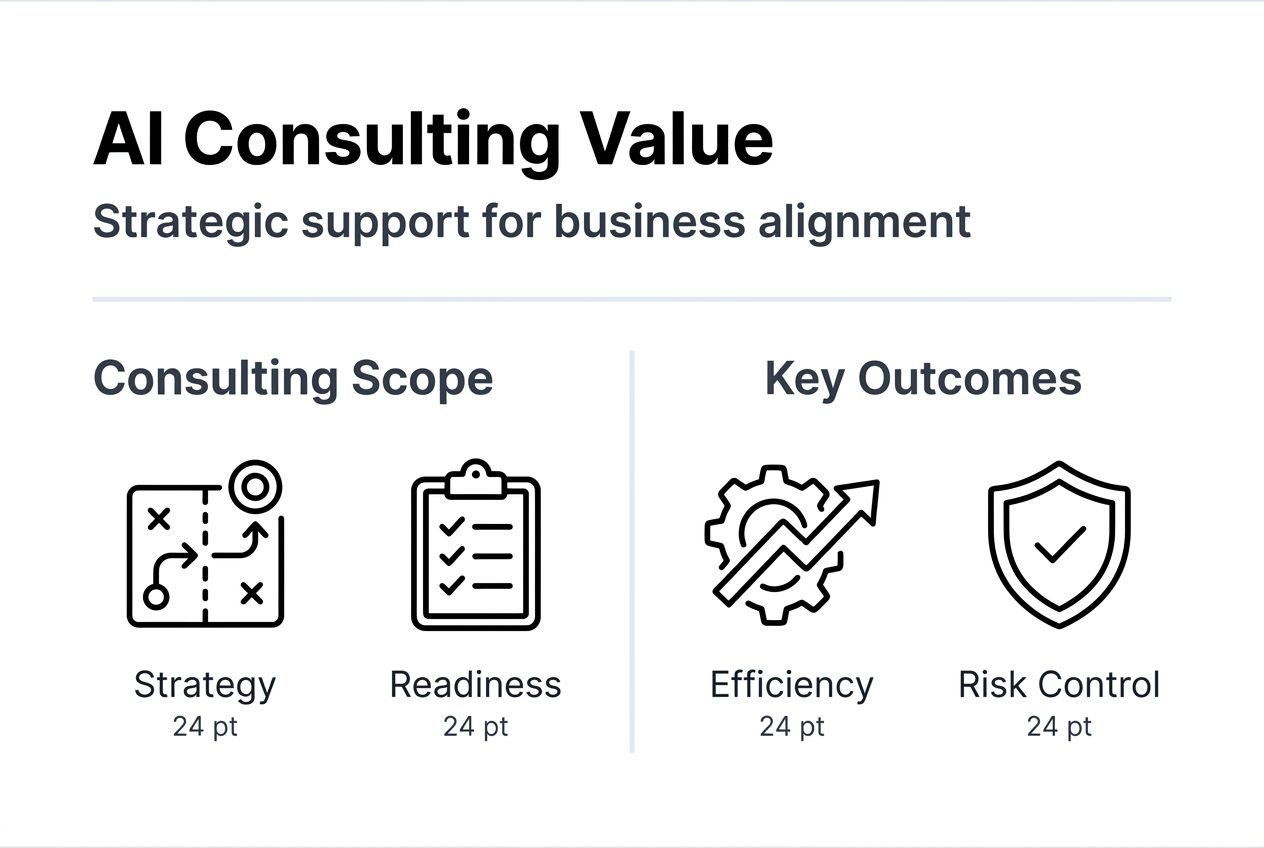
AI consulting delivers strategic guidance for organizations adopting artificial intelligence. Consultants assess readiness, design solutions, and support implementation aligned with business priorities. This specialized practice differs fundamentally from general IT consulting, which addresses broader technology infrastructure without AI-specific expertise.
AI consulting provides strategic guidance specifically for AI adoption beyond generic IT services. Where IT consultants optimize networks or databases, AI consultants evaluate which business processes benefit most from machine learning, natural language processing, or computer vision. They prioritize use cases, manage organizational change, and ensure technical choices support strategic objectives.
Typical AI consulting services include:
- Readiness assessment evaluating data quality, infrastructure, and organizational capability
- Strategy development identifying high-impact use cases and implementation roadmaps
- Solution design specifying algorithms, platforms, and integration approaches
- Implementation support guiding deployment while managing technical and human factors
- Optimization tracking performance and refining models based on business outcomes
This tailored approach ensures AI initiatives solve real problems rather than chase technology trends. Consultants connect executive vision with technical execution, preventing the disconnect that dooms most projects.
Why AI consulting is critical for strategic alignment
Without strategic alignment, AI projects burn resources and deliver nothing. Organizations invest millions in platforms that sit unused or automate the wrong processes. 70% of AI projects fail because teams prioritize technical capability over business impact.
Misaligned initiatives waste effort in three ways. First, teams build solutions for problems executives never prioritized. Second, implementations ignore operational constraints like data availability or workflow compatibility. Third, organizations lack change management strategies, so employees resist new tools regardless of technical merit.
Strategic alignment transforms AI from an expensive experiment into a competitive advantage. Consultants ensure every technical decision serves business goals.
Customized strategies outperform generic approaches because each organization faces unique challenges. A manufacturer needs predictive maintenance, while a retailer requires demand forecasting. One-size-fits-all solutions ignore these differences, producing mediocre results across the board.
Consider a healthcare provider implementing AI diagnostics without consulting support. Technical teams built accurate models, but clinicians rejected the system because it disrupted established workflows. The project failed despite strong technology. A consultant would have identified workflow integration as a critical success factor during initial assessment.
Pro Tip: Engage AI consultants during the planning phase, not after implementation struggles emerge. Early involvement prevents costly missteps and ensures alignment from day one.
Operational benefits driven by AI consulting
AI consulting delivers measurable efficiency gains. Companies see up to a 40% boost in operational efficiency within the first year when engaging AI consulting. These improvements stem from optimized processes, reduced manual work, and better resource allocation.
Consultants mitigate implementation risks by anticipating technical and organizational obstacles. They identify data quality issues before model training begins, preventing garbage-in-garbage-out scenarios. They also design phased rollouts that test assumptions incrementally rather than betting everything on a single launch.
Change management separates successful implementations from abandoned projects. Consultants prepare employees for new workflows, address concerns proactively, and build internal champions who advocate for adoption. This human-centered approach ensures technology actually gets used.
| Metric | Without AI Consulting | With AI Consulting |
|---|---|---|
| Project Success Rate | 30% | 75% |
| Time to Value | 18-24 months | 6-12 months |
| Operational Efficiency Gain | 10-15% | 25-40% |
| Employee Adoption Rate | 40% | 80% |
Pro Tip: Prioritize readiness assessment and change management investment to maximize operational gains. Technical excellence means nothing if users reject the system.
These benefits compound over time. Organizations that establish AI capabilities through consulting build institutional knowledge, enabling faster subsequent implementations. The AI strategy guide for SMEs demonstrates how structured approaches create lasting competitive advantages.
Enhancing customer engagement through AI consulting
AI consulting transforms customer interactions from transactional to personalized. Consultants design systems that analyze behavior patterns, predict preferences, and deliver tailored experiences at scale. Organizations report an average 20% increase in customer interaction metrics after implementing consulting-guided AI solutions.

Retailers use recommendation engines that suggest products based on browsing history, purchase patterns, and similar customer profiles. Service companies deploy chatbots that resolve common issues instantly while routing complex problems to human agents. These AI-powered customer engagement strategies strengthen relationships by making every interaction relevant.
Consultants ensure customer experience design balances automation with human touch. They identify which interactions benefit from AI speed and which require empathy and judgment. This nuanced approach prevents the robotic experiences that damage brand perception.
Key AI-driven customer engagement strategies include:
- Predictive personalization serving content and offers matched to individual preferences
- Conversational AI handling routine inquiries while learning from each interaction
- Sentiment analysis monitoring feedback to identify dissatisfaction before customers churn
- Dynamic pricing adjusting offers based on demand, inventory, and customer value
- Journey optimization identifying friction points and streamlining paths to purchase
These capabilities require sophisticated implementation. AI in customer experience examples demonstrate how retailers leverage consulting expertise to build systems that drive loyalty and revenue growth simultaneously.
Common misconceptions about AI consulting
Many leaders misunderstand AI consulting’s role and value. 60% of business leaders mistakenly believe AI consulting is only for IT teams, viewing it as technical support rather than strategic partnership. This confusion limits AI’s potential by excluding consultants from business discussions where they add most value.
The distinction between consulting and implementation matters. Vendors sell specific products and prioritize deployment. Consultants remain platform-agnostic, recommending solutions that fit business needs rather than pushing proprietary tools. This independence ensures recommendations serve organizational interests.
Another misconception frames AI consulting as an expense rather than an investment. Organizations that skip consulting to save money typically spend more fixing failed implementations. Strategic guidance prevents costly mistakes, making consulting a cost-effective choice despite upfront fees.
Reality check on AI consulting:
- Focus is business transformation and measurable outcomes, not just technology installation
- Consultants provide strategic alignment between AI capabilities and organizational goals
- Engagements span from initial strategy through post-deployment optimization
- Value comes from preventing failures and accelerating time to results
- Best consultants transfer knowledge, building internal capability alongside implementation
Understanding these distinctions helps leaders engage consulting effectively. The what is AI consulting impact business guide clarifies how strategic partnerships differ from vendor relationships.
Framework for understanding AI consulting engagements
AI consulting follows a structured approach ensuring comprehensive coverage of technical and organizational factors. This framework mitigates common failure points by addressing each critical element systematically.
Readiness assessment evaluates data infrastructure, technical capabilities, and organizational preparedness. Consultants audit data quality, identify gaps, and determine whether existing systems support AI workloads. This phase prevents building on unstable foundations.
Use case prioritization ranks opportunities by business impact, technical feasibility, and resource requirements. Not every AI application delivers equal value. Consultants help organizations focus on high-impact initiatives rather than pursuing numerous low-value projects.
Solution design specifies technical architecture, algorithms, and integration points. Consultants balance cutting-edge capabilities with practical constraints like budget, timeline, and existing technology investments.
Implementation support guides deployment while managing technical challenges and organizational resistance. Consultants bridge communication between technical teams and business stakeholders, ensuring everyone understands progress and obstacles.
Post-deployment optimization tracks performance against business objectives and refines models based on real-world results. AI systems improve through iteration, and consultants ensure organizations capture this ongoing value.
| Phase | Primary Objective | Key Deliverables |
|---|---|---|
| Readiness Assessment | Evaluate organizational preparedness | Data quality audit, capability gap analysis, readiness scorecard |
| Use Case Prioritization | Identify high-impact opportunities | Prioritized roadmap, business case documentation, ROI projections |
| Solution Design | Specify technical approach | Architecture blueprint, algorithm selection, integration plan |
| Implementation Support | Guide deployment and change management | Progress tracking, issue resolution, stakeholder communication |
| Post-Deployment Optimization | Maximize business value | Performance monitoring, model refinement, continuous improvement plan |
The sequential process ensures foundations support subsequent phases:
- Conduct comprehensive readiness assessment covering data, infrastructure, and people
- Facilitate workshops identifying business challenges addressable through AI
- Prioritize use cases using weighted scoring across impact, feasibility, and alignment
- Design solutions specifying technical requirements and integration approaches
- Support implementation through pilot testing, full deployment, and user training
- Optimize performance by monitoring metrics, gathering feedback, and refining models
This structured framework transforms abstract AI potential into concrete business results.
Industry-specific benefits of AI consulting
AI consulting delivers context-specific value across sectors. Manufacturing organizations achieve 30-50% downtime reduction through predictive maintenance systems that identify equipment failures before they occur. Sensors monitor vibration, temperature, and performance patterns, triggering maintenance during planned downtime rather than mid-production.
Government agencies improve service delivery through intelligent automation. Public services leverage AI for document processing, citizen inquiry routing, and resource allocation optimization. One municipality reduced permit processing time from weeks to days by automating initial review and compliance checking.
Retail benefits include demand forecasting that minimizes stockouts and overstock situations. Transportation companies optimize routes dynamically based on traffic, weather, and delivery windows. Healthcare providers enhance diagnostic accuracy while reducing clinician burnout through AI-assisted analysis.
Sector-specific AI challenges consultants address:
- Manufacturing: Integrating AI with legacy industrial control systems and managing shop floor adoption
- Government: Navigating regulatory constraints, ensuring transparency, and maintaining public trust
- Retail: Balancing personalization with privacy while handling seasonal demand variability
- Healthcare: Meeting compliance requirements, integrating with electronic health records, and supporting clinical workflows
- Financial services: Managing risk, detecting fraud, and adhering to strict regulatory oversight
Consultants adapt AI to industry constraints rather than forcing generic solutions. They understand sector regulations, operational realities, and stakeholder expectations. This contextual expertise prevents implementations that work technically but fail practically.
The 7 examples of AI use cases for local governments demonstrates how consultants customize approaches for public sector needs. The AI consulting for SMEs cost savings productivity boost guide shows small manufacturers achieving enterprise-level benefits through focused consulting engagements.
Bridging to practical application: choosing and working with AI consultants
Selecting the right AI consulting partner determines project success. Evaluate candidates across four dimensions. First, assess strategic fit by reviewing their approach to business alignment versus pure technical execution. Consultants focused on business outcomes deliver more value than those chasing algorithmic sophistication.
Second, verify industry experience. Consultants who understand sector-specific constraints, regulations, and operational realities implement solutions that actually work. Generic expertise translates poorly across industries with unique requirements.
Third, examine proven impact through case studies and client references. Look for quantified results, not vague claims. Ask about challenges encountered and how consultants addressed them. Problem-solving ability matters more than perfect execution.
Fourth, confirm change management capabilities. Technical success means nothing if employees reject the system. Strong consultants build adoption plans, train users, and create internal champions who sustain initiatives beyond the engagement.
Key selection criteria:
- Strategic business focus demonstrated through outcome-oriented proposals
- Deep industry knowledge evidenced by relevant case studies and sector expertise
- Proven implementation track record with quantified results and client testimonials
- Change management competency including training, communication, and adoption support
- Continuous optimization commitment extending beyond initial deployment
Integration challenges require proactive management. Establish clear governance defining decision rights, communication protocols, and escalation paths. Assign internal champions who work closely with consultants, ensuring knowledge transfer and organizational buy-in.
Measure ROI through predefined metrics aligned with business objectives. Track operational efficiency, customer satisfaction, revenue impact, or cost reduction depending on project goals. Regular reviews keep initiatives focused on outcomes rather than activity.
Pro Tip: Prioritize consultants offering continuous post-deployment optimization support. AI systems improve through iteration, and ongoing partnership captures this value.
Manage collaboration by maintaining transparency, providing timely feedback, and empowering consultants to make recommendations freely. The AI penetration testing approach demonstrates how proactive security assessment prevents vulnerabilities before they become problems.
Explore AI consulting solutions tailored for your business
Strategic AI consulting transforms potential into performance. Organizations across sectors leverage expert guidance to align technology investments with business priorities, achieving measurable gains in efficiency, customer engagement, and competitive advantage.
Comprehensive consulting services span readiness assessment, strategy development, solution design, implementation support, and continuous optimization. Whether you lead a manufacturing operation seeking predictive maintenance or a government agency improving citizen services, tailored approaches address your unique challenges and opportunities.
Explore the AI strategy guide for SMEs for frameworks applicable across organizational sizes. Review public services solutions demonstrating government-specific implementations. The 7 examples of AI use cases for local governments showcases practical applications delivering community value.
Expert support ensures your AI initiatives deliver lasting business impact from initial strategy through deployment and beyond.
FAQ
What is the difference between AI consulting and general IT consulting?
AI consulting focuses specifically on artificial intelligence strategy, adoption, and business alignment. General IT consulting addresses broader technology infrastructure like networks, databases, and enterprise software without specialized AI expertise. AI consultants evaluate which processes benefit from machine learning or automation and ensure implementations serve strategic business objectives rather than just deploying technology.
How does AI consulting improve project success rates?
Consultants ensure AI initiatives align with business objectives from the start, preventing the misalignment that causes 70% of AI projects to fail. They handle organizational change management, address data quality issues proactively, and design phased implementations that test assumptions incrementally. This comprehensive approach increases success rates from 30% to 75% while reducing time to value.
What factors should I consider when choosing an AI consulting partner?
Evaluate strategic fit by confirming the consultant prioritizes business outcomes over technical complexity. Verify industry experience through relevant case studies demonstrating sector-specific knowledge. Examine proven impact with quantified results and client references. Assess change management capabilities including training and adoption support. Prioritize partners offering continuous post-deployment optimization rather than one-time implementations. Strong consultants transfer knowledge while delivering results, building your internal AI capability.
How long does a typical AI consulting engagement last?
Engagement duration varies based on project scope and organizational readiness. Initial assessments typically span 4-8 weeks, while comprehensive strategy development requires 8-12 weeks. Full implementations including pilot testing and deployment range from 6-18 months depending on complexity. Organizations committed to continuous optimization maintain ongoing consulting relationships, reviewing performance quarterly and refining systems based on business results and evolving requirements.
Recommended
- What Is AI Consulting and Its Impact on Business | Artificial Intelligence
- AI Consulting for SMEs: 30% Cost Savings & 40% Boost | Artificial Intelligence
- Blog | Artificial Intelligence
- New Homepage | Artificial Intelligence
- AI In Forex Trading: Transforming Profits And Risk
- 6 Best AI in Customer Experience Examples for Retail – Xverse
Recent Comments